Hemodialysis Access
Creation And Maintenance
The Specialists of Michigan Vascular Center are dedicated to improving the quality of life for hemodialysis patients. Hemodialysis access for these individuals is an increasingly challenging field, and requires meticulous surgical and endovascular techniques in many cases.
Vascular access is a special passageway to your bloodstream, created by a minor surgery. It is a connection between an artery and a vein used for hemodialysis. A good access will allow you to get the full benefit of dialysis and feel as healthy as possible.
There are two types of permanent vascular access. Both types of access have one thing in common: to make it easier to reach your blood vessels for dialysis.
- AVF - Arterial Venous Fistula: A fistula (artery + vein) is made by sewing an artery to a vein, usually in your arm.
- AVG - Arterial Venous Graft: A graft is like a fistula because it connects an artery to a vein. The difference is that a graft uses an implanted tube to connect the two, like a bridge.
WHY CHOOSE A VASCULAR SURGEON TO MAINTAIN YOUR ACCESS?
Vascular Surgeons are experts in the treatment of arteries and veins. We specialize in providing reliable access, so that your Nephrologist (Kidney Doctor) may treat you with hemodialysis. Whether you're referred for a fist time fistula, or have a complex access problem, we will find a solution to keep your dialysis flowing.
MVC surgeons have been serving the dialysis population of mid-Michigan for over forty years. They follow the "fistula first" initiative, which seeks to use natural vein fistulas as much as possible. They are also actively involved in several clinical trialsin the field of hemodialysis access.
Since September 2005, MVC has consolidated the diagnostic, decision-making and endovascular management of hemodialysis patients into the Michigan Vascular Access Center. This office is a "one-stop-shop" for AV fistula management, often saving the patient trips to multiple locations. A second office, MVCS, bringing the same capabilities to patients in Saginaw County opened in the Spring of 2013.
KEEPING YOUR ACCESS HEALTHY
Maintaining a healthy fistula or graft is vital. Abnormal signs and symptoms to watch for are cold, numb or painful fingers or hand; arm or hand swelling; a change in the thrill of "buzz;" high venous pressure during dialysis; poor clearances; decrease in BFR (blood flow rate); or prolonged bleeding after dailysis.
Different types of testing and treatments may be necessary for the placement and preservation of your access. The following are examples of these tests.
TYPES OF TESTING WE PROVIDE
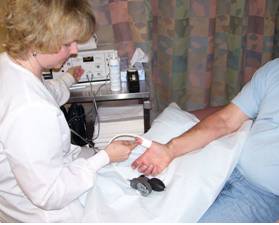
- Doppler: Doppler is a painless exam to check the blood flow in the arteries and fingers, similar to taking a blood pressure.
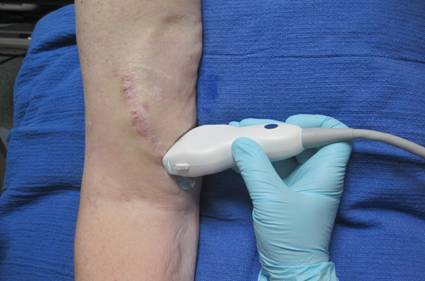
- Duplex / Ultrasound Exam: Duplex is a painless ultrasound exam to evaluate your AVF or AVG.
- Venogram / Fistulogram: A minimally invasive x-ray in which your access is injected with dye. This allows us to determine if there are any problems with your access.
TREATMENTS WE PROVIDE IN THE OFFICE SETTING
- Angioplasty / Ballooning: This is a procedure done to repair and improve the blood flow in your AVF or AVG. During the angioplasty, the doctor threads a balloon tipped catheter to the site of narrowing and inflates the balloon to open the blocked or narrowed area.
- Declotting: This is a technique to clean out an access which is plugged with blood clots and preventing proper dialysis. In this a procedure, a catheter is inserted through a small puncture into your AVF or AVG. A device is advanced through the catheter which breaks the clot into small particles which are then removed.
- Stenting: This is an expandable wire mesh tube that can be placed into a narrowed area of your fistula. A stent is inserted under x-ray and in conjunction with ballooning. A stent is a permanent device and is left in your AVF or AVG.
- Ligation / Coiling of Side Branches: This is done to AVFs that may have low blood flow or are non-maturing. In the coil technique, a wire coil is inserted into small side vessels that are stealing blood flow from the main channel of your fistula. The coil is permanent and helps in the matuation of the fistula.
- Temporary dialysis catheter (sometimes refered to as Perma-cath) placement and maintenance.